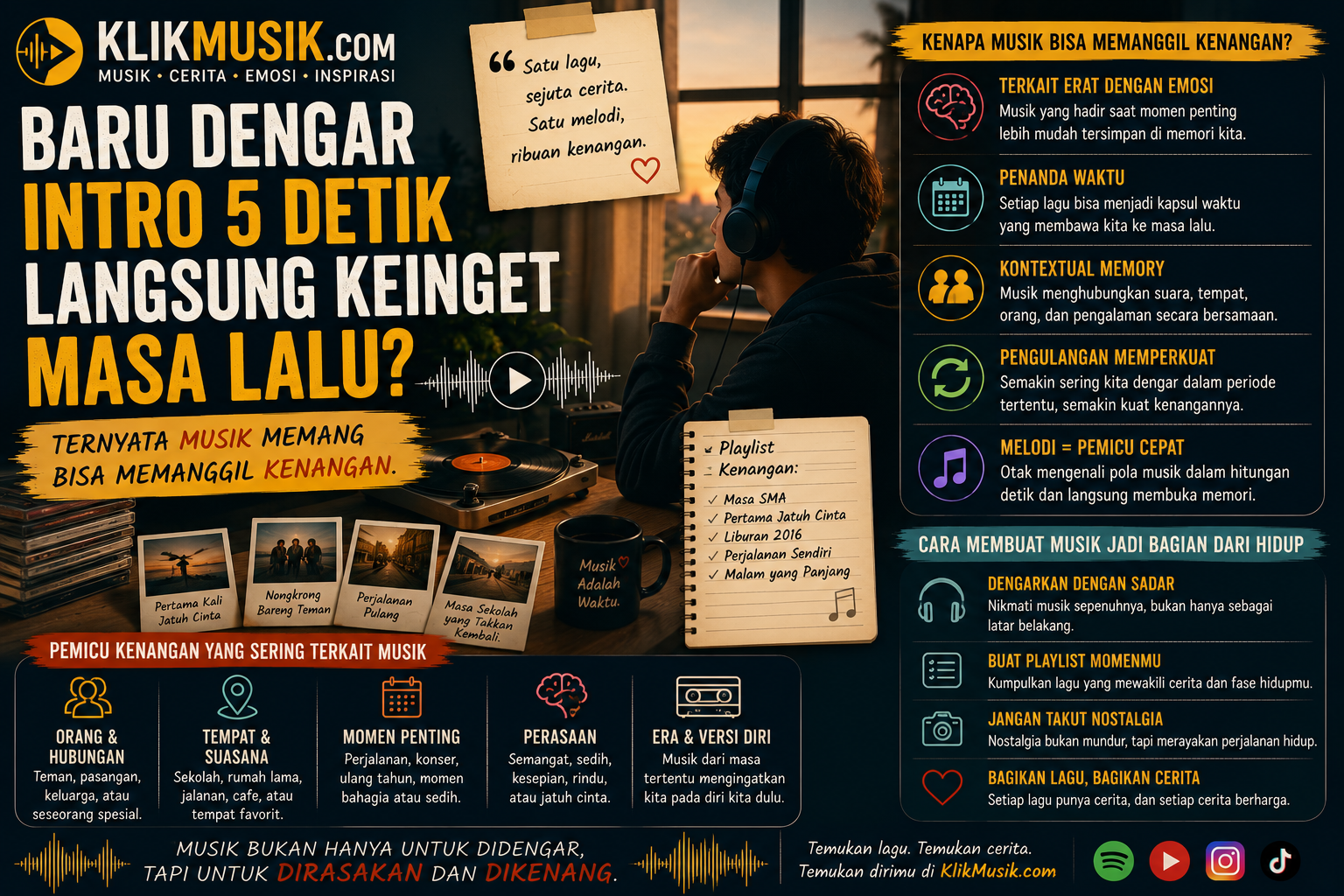
Kadang cuma butuh:
tiga detik.
Satu intro.
Satu chord.
Satu suara drum.
Satu potongan vokal.
Dan tiba-tiba kita bukan lagi berada di:
Kita kembali ke:
Atau bahkan lebih jauh.
Bukan secara literal.
Tapi perasaan itu muncul sangat jelas.
Kita ingat:
tempat.
orang.
cuaca.
jalan.
bahkan detail yang sebelumnya terasa sudah hilang.
Padahal sebelum lagu itu diputar:
kita tidak sedang memikirkan masa tersebut sama sekali.
Lalu muncul pertanyaan:
kenapa musik bisa begitu kuat memanggil kenangan?
Musik Tidak Disimpan Otak Sebagai “Suara” Saja
Ketika mendengarkan lagu, kita tidak hanya memproses:
melody.
rhythm.
lyrics.
Tapi juga:
context.
emotion.
place.
people.
moment.
Semua bisa terikat dalam satu pengalaman.
Jadi sebuah lagu bisa menjadi seperti:
shortcut menuju memory tertentu.
Lagu Bisa Menjadi Penanda Waktu
Ada lagu yang begitu kita dengar:
langsung tahu era-nya.
Bukan hanya tahun rilis.
Tapi:
era hidup kita.
“Ini lagu waktu masih sekolah.”
“Ini lagu waktu kerja pertama.”
“Ini lagu waktu sering nongkrong di tempat itu.”
Music becomes timestamp.
Bahkan Lagu Biasa Bisa Jadi Sangat Personal
Secara objektif:
lagunya biasa saja.
Bukan masterpiece.
Tapi bagi kita:
sangat penting.
Kenapa?
Karena lagu itu menemani moment yang penting.
Nilai emosional datang bukan hanya dari kualitas musik.
Tapi dari:
apa yang terjadi saat kita mendengarnya.
kenapa lagu bisa membangkitkan kenangan
Salah satu alasan kenapa lagu bisa membangkitkan kenangan adalah karena musik sering didengar bersamaan dengan pengalaman emosional tertentu. Ketika sebuah lagu berulang kali hadir pada masa sekolah, hubungan, perjalanan, keluarga, atau fase hidup tertentu, otak dapat menghubungkan suara tersebut dengan konteks yang lebih luas sehingga ketika lagu itu diputar kembali, memori dan emosi lama ikut muncul.
Inilah yang membuat:
satu lagu
bisa membawa:
satu dunia.
Emosi Membuat Memori Lebih Kuat
Kejadian yang memiliki emotional significance biasanya lebih mudah diingat.
Bahagia.
sedih.
takut.
jatuh cinta.
patah hati.
excited.
Dan musik sangat efektif memicu emotion.
Jadi ketika:
strong emotion + music
terjadi bersamaan,
association bisa sangat kuat.
Lagu Putus Cinta Jadi Lebih “Nempel”
Bukan hanya karena liriknya relatable.
Tapi karena kita mungkin mendengarkan lagu tersebut berulang kali saat sedang:
grieving.
confused.
lonely.
Setiap replay memperkuat association.
Repeat Memperkuat Memory
Semakin sering lagu diputar dalam satu periode hidup:
semakin besar kemungkinan lagu tersebut menjadi penanda era.
Dulu:
CD.
MP3.
iPod.
radio.
Sekarang:
playlist.
streaming.
Loop tetap loop.
Lagu Favorit Saat Umur Tertentu Bisa Bertahan Lama
Banyak orang merasa musik yang didengar saat:
remaja
atau
early adulthood
punya emotional power yang sangat besar.
Kenapa?
Karena masa tersebut penuh dengan:
first experiences.
identity development.
social connection.
intense emotion.
Music becomes part of self-story.
Reminiscence Bump
Dalam psychology memory, ada konsep bahwa orang dewasa sering mengingat secara kuat pengalaman dari masa remaja dan early adulthood.
Music from that era can become especially emotionally potent.
It doesn’t mean everyone has exact same age range.
But pattern is interesting.
hubungan musik dan memori
Dalam hubungan musik dan memori, lagu dapat bertindak sebagai cue yang memicu kembali informasi yang sebelumnya tersimpan bersama pengalaman tertentu. Intro, melodi, lirik, atau bahkan karakter suara tertentu bisa menjadi pemicu yang membawa seseorang pada memori autobiografis—yaitu ingatan tentang kejadian dan pengalaman dalam hidupnya sendiri.
Makanya:
kita tidak hanya “ingat lagunya.”
Kita ingat:
siapa diri kita ketika mendengar lagu itu.
Autobiographical Memory
Ini adalah memory tentang:
our own life.
Contoh:
hari pertama sekolah.
trip.
relationship.
family dinner.
first job.
Music can attach to these.
Context-Dependent Memory
Memory retrieval can be influenced by context.
Kalau cue yang sama muncul:
memory lebih mudah accessed.
Music is a powerful contextual cue.
Intro Bisa Lebih Powerful daripada Chorus
Kenapa?
Karena intro adalah:
first recognition signal.
Begitu otak mengenali pattern:
memory network activated.
Belum sampai chorus pun:
perasaan sudah muncul.
Recognition Is Extremely Fast
Otak bisa mengenali familiar song dari potongan sangat singkat.
Especially if listened many times.
Timbre Bisa Jadi Trigger
Bukan cuma melody.
Suara:
guitar tone.
synth.
snare.
vocal texture.
production style.
Can immediately signal era.
Production Sound Itu Punya “Bau Zaman”
80s:
synth.
gated drums.
90s:
certain guitar/production.
2000s:
different compression/pop aesthetics.
2010s:
EDM influence.
Sound itself becomes historical cue.
Radio Jingle Bisa Lebih Nostalgic daripada Lagu
Lucu tapi nyata.
Jingle TV.
opening cartoon.
game sound.
startup computer sound.
Semua bisa memicu nostalgia.
Because repetition + context.
Sound Design Is Memory Too
Boot sound Windows lama.
Nokia ringtone.
PlayStation startup.
Not exactly songs.
Still powerful.
Why?
Because they accompanied:
daily routine.
Repeated exposure.
Game Music Bisa Sangat Emosional
Main game ratusan jam.
Background music repeatedly plays.
Years later:
one soundtrack.
Boom.
Back to bedroom.
Old console.
School holiday.
Memory attached.
Anime Opening
Same effect.
Episode after episode.
Years.
Friend discussions.
School period.
Opening becomes era marker.
Movie Soundtrack
Film + emotion + music.
Director knows this.
Music strengthens scene memory.
Later hearing soundtrack alone:
scene returns.
Advertising Also Uses This
Brand jingles.
Short melodies.
Repeated.
Designed to stick.
Earworm
Song repeats in head.
Catchy melodic/rhythmic structures increase memorability.
But earworm isn’t exactly same as nostalgia.
Related, not identical.
Lyrics Can Become Personal Script
A line appears at right moment.
We adopt it.
“This song understands me.”
Later:
same lyric brings back old mindset.
Sometimes We Misremember Lyrics But Still Feel Nostalgia
Because emotional association isn’t dependent on perfect factual recall.
Memory is reconstructive.
Memory Is Not Video Recording
Important.
When remembering:
brain reconstructs.
Details can change.
Music may evoke a vivid feeling without every remembered detail being accurate.
Nostalgia Is Not Perfect Historical Accuracy
We can remember:
“those days were amazing.”
But maybe they weren’t.
Memory filters.
Rosy Retrospection
People sometimes remember past more positively than it actually felt in real time.
Music can strengthen that romanticization.
Old Songs Can Make Past Feel Better
Not because the past was objectively better.
But because:
current problems weren’t part of memory cue.
“Musik Dulu Lebih Bagus”
Maybe.
Or maybe:
music from youth carries stronger emotion.
Taste + nostalgia overlap.
Generational Music Arguments
“Lagu sekarang jelek.”
Every generation says this.
Part of effect:
familiarity + identity + memory.
Mere Exposure Effect
Repeated exposure can increase preference.
If heard a song dozens of times:
it becomes familiar.
Familiarity often feels comfortable.
Nostalgia + Familiarity = Strong Combination
Old favorite songs become emotionally safe.
That’s Why People Replay Old Playlists During Stress
Familiar music:
predictable.
comforting.
linked to known memories.
Novel Music Requires More Attention
Old song:
brain already knows structure.
Less uncertainty.
Can feel calming.
But New Music Can Become Future Nostalgia
This is the beautiful part.
Song you hear today?
Might be 2036 nostalgia.
You don’t know yet.
Current Ordinary Moment Can Become Important Later
Driving home.
Random cafe.
Friend conversation.
Song playing.
Years later:
that song unlocks the scene.
Playlist Becomes Diary
A playlist from:
Can document life more emotionally than photos.
Seasonal Playlists
Rainy season.
December.
Ramadan.
Road trip.
Beach.
Workout.
Music becomes environmental memory.
Holiday Songs Show This Clearly
Christmas songs.
Lebaran songs.
New Year tracks.
Played in same seasonal context repeatedly.
Cue becomes collective memory.
Collective Nostalgia
Not only personal.
Some songs trigger memory shared by:
generation.
country.
community.
National Songs
Ceremonies.
school.
events.
Strong collective association.
Music Can Trigger Memory of People
Maybe strongest effect.
A person had:
favorite song.
shared playlist.
concert.
Car ride.
Then relationship ends.
Song remains.
“Our Song”
Classic phenomenon.
Song becomes relational symbol.
After Breakup, Song Can Hurt
Because cue triggers:
person + place + emotion.
Avoiding song temporarily can happen naturally.
Later, Emotional Meaning Can Change
Years pass.
Same song.
Pain decreases.
Now maybe:
warm nostalgia.
Memory reconsolidation and changing context can shift emotional response.
Songs Can Be “Reclaimed”
A song once tied to one person can gain new associations.
Play it:
on new trip.
with new friends.
New memories layer.
Music Memory Isn’t One-to-One
One song can hold:
multiple chapters.
First Association Often Dominates
But not forever.
Smell and Music Are Both Strong Memory Cues
People often compare music nostalgia to scent nostalgia.
Smell can instantly bring childhood memories.
Music similarly provides rich cue structure.
Why Scent Can Feel Even More Sudden
Olfactory systems have close relationships with emotion/memory circuits.
But music adds:
time.
structure.
expectation.
So emotional build can be different.
Music and Memory in Dementia Context
Music can sometimes remain meaningful even when other memory abilities decline, and music-based activities are used in some care settings.
But this is a medical/care context that needs careful professional handling.
We don’t need overclaim.
Familiar Songs Can Support Engagement
Important nuance:
not a cure.
But potentially useful cue for connection and reminiscence in appropriate care.
Music Therapy Is a Profession
Not just “play sad playlist.”
Trained music therapists use structured interventions.
Don’t Call Every Playlist “Therapy”
Music can be therapeutic.
That’s different from clinical music therapy.
Mood Regulation
People use music intentionally to:
energize.
calm.
cry.
focus.
process.
Memory plays role.
Sad Music Can Feel Good
Paradox.
We listen to sad songs when sad.
Why?
Potential reasons:
validation.
emotional processing.
aesthetic pleasure.
safe sadness.
Music Gives Emotion Structure
Instead of vague sadness:
song gives:
melody.
words.
beginning.
end.
This can feel manageable.
Crying to a Song Can Feel Cathartic
For some.
Not universal.
Upbeat Music Can Shift Energy
Rhythm.
tempo.
association.
But don’t make simplistic “happy song cures sadness” claims.
Music and Emotion Is Individual
Same song:
one person happy.
another person cries.
Because memory differs.
This Is Why Algorithm Can’t Fully Predict Taste
It can model behavior.
But personal history remains unique.
Spotify Knows You Played It 80 Times
It doesn’t fully know:
why.
Data Knows Pattern, Not Full Meaning
Interesting difference.
Shared Playlist Is Relationship Object
Like mixtape era.
Before:
cassette.
CD.
Now:
streaming playlist.
Same human behavior:
curate songs for someone.
Mixtape Had More Friction
Choose.
record.
order.
physical object.
Effort increased symbolic value.
Playlist Is Easier but Still Meaningful
Track order.
title.
cover.
All communicate.
Song Order Can Tell Story
Start energetic.
middle emotional.
end calm.
Curation is creative act.
Personal Music Library Is Memory Archive
Old MP3 folders.
Downloads.
Weird file names.
They document era.
“Track01.mp3”
You know.
Pirated MP3 Era Had Its Own Nostalgia
Winamp.
LimeWire.
Bluetooth transfer.
Infrared.
Memory attached to technology too.
Technology Changes How We Remember Music
Radio era:
wait for song.
CD:
album sequence.
MP3:
shuffle.
Streaming:
infinite access.
Different listening habits.
Scarcity Can Strengthen Attachment
If only owned 20 CDs:
listen repeatedly.
Now access millions.
Attention spreads.
Album Familiarity May Be Lower Today for Some Listeners
Not always.
But infinite choice changes behavior.
Shuffle Creates Unexpected Memory
Random old song appears.
Instant time travel.
“On Repeat” Playlists Capture Current Phase
Streaming platform features can later become memory snapshot.
Year-End Recaps Are Basically Nostalgia Machines
Top songs.
Minutes.
Artists.
Numbers become autobiographical cue.
But Listening Stats Don’t Tell Full Story
Most played song might be:
sleep track.
kid’s favorite.
gym playlist.
Context matters.
Song Skips Are Interesting Too
Some songs too emotionally loaded.
Avoid.
Memory Can Make Music Hard to Hear
Not all nostalgia pleasant.
Some cues trigger:
grief.
loss.
trauma.
Important.
If a Song Brings Distress
No need force exposure casually.
Take distance.
Seek support if emotional reaction is intense/persistent and affecting functioning.
Not All Nostalgia Is Healthy or Unhealthy
Depends impact.
Nostalgia Can Provide Continuity
Reminds:
“I was that person.”
Connects past self to current self.
Identity Is Narrative
Music helps soundtrack narrative.
Teen Music Becomes Identity Badge
Genre:
punk.
metal.
hip-hop.
K-pop.
indie.
EDM.
Not only preference.
Community.
clothes.
friends.
values.
Taste Can Signal Belonging
“People like us listen to this.”
Social identity.
Concert Memory Is Extremely Strong
Music + crowd + lights + anticipation.
Multisensory.
Powerful encoding.
Live Performance Creates Shared Emotional Peak
Thousands sing same lyric.
Hard to forget.
Hearing Studio Version Later Can Trigger Concert Memory
Same cue.
Different context layered.
Festival Songs
One song becomes “that summer.”
Road Trip Songs
Maybe strongest cliché because true.
Same playlist.
scenery.
friends.
hours.
Association deep.
Car Audio Has Special Memory Quality
Enclosed environment.
Repeated routes.
Daily commute.
Songs become tied to roads.
Certain Roads Can Trigger Songs Mentally
Reverse direction too.
Place triggers music.
Memory network works both ways.
Music Can Trigger Place, Place Can Trigger Music
Bidirectional association.
Workout Music
Repeatedly paired with physical state.
Later song can increase motivation simply through learned association.
Conditioning-Like Associations
Not exact classical conditioning in every case.
But repeated pairing shapes response.
Study Music
Same playlist while studying.
Later may cue focus.
For some.
But Lyrics Can Disrupt Verbal Tasks
Especially unfamiliar lyrics.
Instrumental may help.
Familiar Music May Become Less Distracting
Again individual.
White Noise vs Music
Different tool.
This article about memory, not productivity.
Lullabies
Childhood.
Parent voice.
Safety.
Music-memory connection starts early.
Family Songs
Songs played by parents.
Even if we hated them as kids:
later nostalgia.
“Dad Music”
Suddenly at 30:
sounds good.
Dangerous.
Intergenerational Memory
Children inherit songs through family.
Music becomes family archive.
Old Song Can Connect to Someone Who Is Gone
This can be beautiful and painful.
Music acts as emotional bridge.
Funeral Songs
Very strong associations.
Afterward song may always carry that event.
Weddings
First dance song.
Ceremony music.
Same.
Ritual Strengthens Association
Repeated significant context.
Religious Music
Can trigger:
spiritual memory.
community.
ritual.
place.
Emotion + repetition.
School Songs
Graduation songs.
Anthem.
Performance.
Collective nostalgia.
Advertising Songs Can Hijack Songs
A track becomes:
“that commercial song.”
Association changes.
Movie Can Also Recontextualize Old Song
Old song inserted into famous scene.
New generation associates it with movie.
TikTok Can Recontextualize Music Again
Old song becomes trend.
Teenager knows trend.
Parent knows original era.
One track, two nostalgia systems.
Music Can Have Multiple Generations of Meaning
Fascinating.
Sampling Does Similar Thing
Old recording inside new track.
Past and present combined.
Younger Listener Discovers Original Through Sample
Memory chain across generations.
Covers
Same song.
Different arrangement.
Can trigger original memory while creating new one.
Acoustic Version Feels Different
Harmony same.
Timbre changed.
Emotion changes.
Tempo Changes Emotional Perception
Slower cover:
more melancholic.
Fast:
energetic.
Association can be rewritten.
Key Change, Arrangement, Production
All shape emotion.
But Familiar Melody Is Anchor
Recognition keeps memory connection.
Why Instrumental Version Can Still Trigger Memory
Lyrics unnecessary if melody encoded strongly.
Why Misheard Lyrics Don’t Break Nostalgia
Sound pattern matters.
Language Can Be Unknown Yet Music Emotional
We can attach memories to foreign songs without understanding lyrics.
Context + sound enough.
K-Pop / Japanese Songs / Western Songs
Listener may not speak language.
Still strong emotional associations.
Meaning Can Come Later
Learn translation years later.
Song gains another layer.
Sometimes Lyrics We Loved as Teen Make No Sense as Adult
Nostalgia survives.
Musical Taste Evolves
We can outgrow genre.
But certain songs remain.
Nostalgia Playlist Is Not Same as Current Taste
Important.
Song can be beloved historically, not stylistically.
“Gue Nggak Akan Denger Lagu Baru Kayak Gini”
But old similar song?
Exception because memory.
Familiarity Has Privilege
New Artist Competes Not Only With Old Music Quality
But old memories.
Hard battle.
That’s Why Comparing Eras Is Unfair
New song hasn’t had 15 years to become meaningful.
Give New Music Time
Some songs are growers.
First listen:
meh.
Ten listens:
favorite.
Immediate Hook vs Long-Term Attachment
Different.
Deep Listening Builds Memory
If song is background only:
association may still form.
But focused listening creates richer detail.
Album Listening
Sequence creates contextual memory.
Track transitions.
Artwork.
Era.
Physical Media Adds Sensory Cues
Vinyl sleeve.
CD booklet.
Cassette.
Touch + visual + sound.
More retrieval cues.
Streaming Is Less Physical
But playlists/cover art still cues.
Vinyl Nostalgia Isn’t Only Sound
Ritual.
object.
collection.
memory.
Music Collecting Is Memory Collecting
Every record has:
where bought.
who with.
why.
Concert Ticket Stubs
Physical cue.
Screenshots of Old Playlists
Digital equivalent.
Save Your Playlists
Future you may appreciate.
Playlist Naming Matters
Instead of:
Playlist 14.
Use:
Bali July 2026.
Rainy Nights 2026.
Now future memory cue stronger.
Add Date
Simple archive trick.
Music Journal?
For enthusiasts:
song + moment + note.
Could be fun.
But Don’t Over-document Everything
Living moment matters more.
Nostalgia Works Best When Unexpected
Shuffle surprise.
Radio.
Cafe.
If intentionally replay every day:
effect can reduce.
Habituation
Repeated exposure can reduce emotional intensity temporarily.
A Song You Avoid for Years Can Hit Harder
Distance restores surprise.
Silence Between Eras Matters
Music Can Make Time Feel Collapsed
One moment:
present.
Next:
emotionally 16 again.
This is why people call it time machine.
It’s Not Literal Time Travel
But subjectively powerful.
Brain Reconstructs Self-State
Not only scene.
We may remember:
how we felt about future.
who we wanted to be.
This Can Be Bittersweet
Pride.
regret.
gratitude.
loss.
All together.
Nostalgia Often Contains Mixed Emotion
Happy + sad.
That’s part of its unique feeling.
Bittersweet Is Key
We enjoy memory while knowing:
it cannot fully return.
“I Miss That Time”
Sometimes we don’t want literal life back.
We miss:
simplicity.
people.
version of self.
Music reveals that.
Ask: What Exactly Do I Miss?
Interesting self-reflection.
Song Can Help Understand Change
Old lyrics interpreted differently now.
That shows growth.
Same Song, Different Person Listening
You.
Ten years later.
Art Stays, Listener Changes
This is one reason great songs endure.
Meaning Evolves
ClickMusik.com Can Own This Angle
Not only:
artist news.
song releases.
But:
why music matters in everyday life.
That gives site more depth.
Content Cluster Could Include
music and memory.
music and mood.
why songs get stuck.
why sad songs feel good.
how playlists affect identity.
why old songs feel better.
album vs playlist listening.
Great evergreen content.
Future Article Ideas
- Kenapa Lagu Sedih Justru Enak Didengar Saat Lagi Sedih?
- Kenapa Lagu Bisa Terus Terngiang di Kepala?
- Kenapa Musik Waktu Remaja Terasa Lebih Spesial?
- Playlist vs Album: Apakah Cara Kita Mendengarkan Musik Sudah Berubah?
- Kenapa Lagu Lama Kadang Terdengar Lebih Bagus daripada Lagu Baru?
- Kenapa Musik Live Terasa Lebih Emosional daripada Rekaman?
Natural.
Practical Experiment
Open playlist from five years ago.
Don’t skip.
Listen first 10 songs.
Notice:
what appears?
Person?
place?
emotion?
maybe surprising.
Don’t Force Memory
Let it come.
One Song, One Story
Ask friends:
“Lagu apa yang langsung bawa lo ke satu masa?”
Great conversation.
Music Is Social Memory
People share stories through songs.
Send Old Song to Friend
“Bro inget ini?”
Instant connection.
But Be Sensitive
Some songs tied to painful memories.
Know person.
Nostalgia Content Works Because Everyone Has Version
Genre differs.
Mechanism similar.
Different Generation, Same Experience
Dad hears 80s.
You hear 2010s.
Teen hears 2026.
Everyone says:
“music from my era.”
In 2040…
Today’s viral track may trigger:
school.
first job.
current friend group.
Funny.
We Rarely Know Which Song Will Become Important
It happens accidentally.
That’s Why Everyday Listening Matters
Music is quietly recording life.
Not digitally.
Emotionally.
Kesimpulan
Musik bisa membangkitkan kenangan dengan sangat cepat karena lagu tidak tersimpan di pikiran sebagai suara yang berdiri sendiri.
Saat kita mendengarkan musik, lagu tersebut sering hadir bersama:
orang tertentu,
tempat tertentu,
rutinitas,
perjalanan,
hubungan,
dan emosi yang sedang kuat pada masa itu.
Ketika bertahun-tahun kemudian intro yang sama muncul lagi, musik bertindak seperti:
cue.
Dan tiba-tiba bagian lain dari memory ikut terbuka.
Itulah kenapa lima detik pertama sebuah lagu bisa membuat kita kembali mengingat:
kamar lama.
jalan pulang.
mantan.
teman sekolah.
mobil keluarga.
atau versi diri kita yang sudah lama berubah.
Menariknya, nostalgia tidak selalu berarti kita benar-benar ingin kembali ke masa tersebut.
Kadang kita hanya merindukan:
perasaan yang dulu ada di sana.
Dan sebuah lagu kebetulan menyimpannya dengan sangat baik.
Jadi kalau suatu hari shuffle memutar lagu lama dan tiba-tiba kita diam beberapa detik karena terlalu banyak hal yang muncul di kepala:
itu bukan cuma karena lagunya bagus.
Mungkin lagu tersebut pernah menjadi:
soundtrack dari satu bagian hidup kita.
Dan walaupun moment itu sudah lewat, musik punya kemampuan unik untuk membuatnya terasa dekat lagi.
Setidaknya selama:
tiga menit empat puluh detik.
Sampai lagu berikutnya mulai diputar.